

One Whale, 74 Batons and a Million Pieces of Plastic
As the Commonwealth Clean Oceans Plastics Campaign closes in on one million pieces collected, communities are proving there is more than one way to tackle a global problem.
In 1949, scientists working in the waters off Bermuda recorded a haunting, unfamiliar sound. They did not know what it was, so they set it aside. It sat in an archive for nearly 77 years until February 2026, when researchers at Woods Hole Oceanographic Institution identified it as the earliest known recording of a humpback whale song.
On that same island, an artist is now building a whale. Not from stone or bronze, but from the plastic debris recovered during the King's Baton Relay's visit to Bermuda, pulled from the same waters that provided that first, forgotten song.
Across the Commonwealth, from the canals of Nigeria to the seabed off Barbados, all 74 of the Commonwealth nations and territories are part of the same improbable, ambitious, increasingly urgent story: the Commonwealth Clean Oceans Plastics Campaign, and its race to remove one million pieces of plastic from Commonwealth oceans and waterways before the Games begin in Glasgow on 23 July.
The campaign, a partnership between the Royal Commonwealth Society and Commonwealth Sport, is woven into the fabric of the reimagined King's Baton Relay, which has been travelling through all 74 Commonwealth nations and territories since its launch at Buckingham Palace on Commonwealth Day 2025.
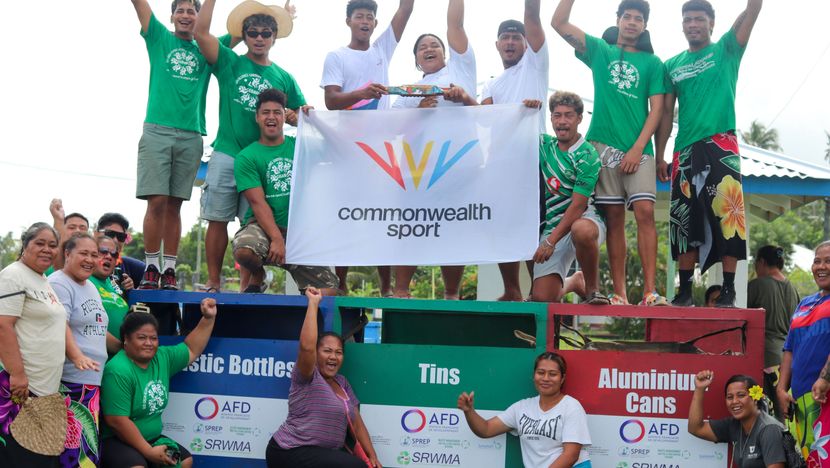
In each nation, young people, athletes, conservation groups and local communities have come together to participate in a plastic clean-up.
The Commonwealth accounts for one third of the world's ocean waters. Almost half its members are Small Island Developing States, the places that have contributed least to the plastic crisis but suffer the most from it. The target is straightforward: prevent one million pieces of plastic from entering Commonwealth waterways before the Glasgow 2026 Commonwealth Games kick off.
What nobody quite anticipated was the imagination behind the plastic clean ups.
In Nigeria, they did it by canoe. In Uganda and Barbados, divers went underwater, recovering waste hidden beneath the surface.
Elsewhere, the focus has shifted from collection to transformation. In the British Virgin Islands, collected plastic has become a public bench. In Cameroon, it inspired a recycled fashion parade. In Singapore, the Ocean Purpose Project is turning recovered waste into aquaculture equipment, construction panels and 3D printing material. In Kenya, collected plastic has been built into a sailing boat.
For others, the campaign has become inseparable from conservation. From seals on Namibia's coast to turtles in Gabon and elephants along Botswana's Chobe River, the campaign has become as much about protecting wildlife as removing plastic.
In Antigua and Barbuda, a visual installation was built to represent what one million pieces of plastic actually looks like. It stops people cold.
In Mozambique, the Blue Coins programme is rewarding communities in local currency for collecting waste, turning environmental action into something with immediate economic value.
Australia has gone further still. Recovered plastic has been made into sunglasses. Discarded fishing net materials have been engineered into solar panels and phone chargers.
And last year, volunteers from Tangaroa Blue went into Cape York, the northernmost tip of the Australian mainland, one of the most geographically isolated stretches of coastline on earth and, carried on Pacific currents, one of the most polluted.
The plastic they pulled off that beach has been processed and turned into bag tags; the luggage labels that Australian athletes will carry to Glasgow next month. Every athlete who travels to Scotland will be carrying a piece of Cape York with them.
The numbers tell their own story. The Caribbean leg of the Relay alone, covering the first 90 days, produced more than 167,500 pieces of plastic removed by over 1,500 volunteers. Since then, the Baton has moved through Africa, Asia, Oceania and the Americas and is now completing its European leg. The live total now sits at +759,000 pieces of plastic and still climbing. With the Opening Ceremony fast approaching, the million is not just achievable. It is coming.
As World Environment Day and World Oceans Day are recognised, the race towards one million pieces continues. Yet the most enduring legacy of the campaign may not be the final number. It may be the creativity, commitment and optimism shown by communities across the Commonwealth who have chosen not simply to collect plastic, but to rethink what happens next.
